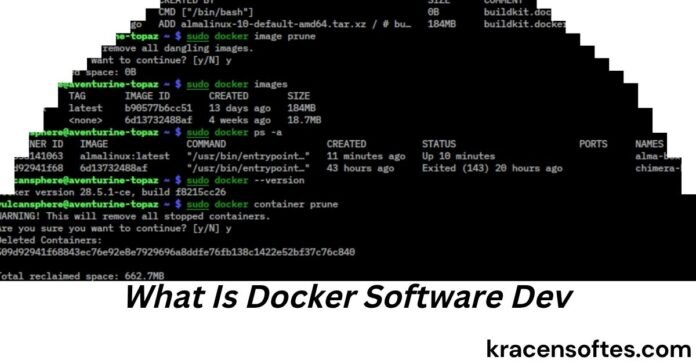
Docker has transformed the way developers build, test, and deploy applications. Whether you are a beginner learning software development or an experienced engineer working with cloud-native applications, understanding Docker is now one of the most valuable technical skills you can have.
If you’ve searched for “what is docker software dev”, you’re probably wondering what Docker actually does, why companies use it, and how it fits into modern software development.
The simple answer is that Docker is a containerization platform that allows developers to package applications along with everything they need to run. This means an application behaves the same way on a developer’s laptop, a testing server, and a production environment.
However, Docker is much more than just containers. It has become a standard technology for software development, DevOps, cloud computing, continuous integration (CI), continuous deployment (CD), and microservices.
In this complete guide, you’ll learn everything about what is docker software dev, including how Docker works, why developers love it, its architecture, real-world applications, benefits, limitations, best practices, and why it continues to shape modern software development in 2026.
What Is Docker Software Dev?
The term “what is docker software dev” refers to the use of Docker as a software development platform that packages applications into lightweight, portable environments called containers.
Instead of installing software directly on an operating system, developers create Docker containers that include:
- Application source code
- Runtime environment
- Libraries
- Dependencies
- Configuration files
- Required system tools
Everything needed to run the application is bundled together.
As a result, developers no longer hear the famous phrase:
“It works on my machine.”
If it works inside a Docker container, it works almost anywhere Docker is installed.
This consistency has made Docker one of the most important tools in software engineering.
What Is Docker?
Docker is an open-source containerization platform introduced in 2013.
Its purpose is simple:
Build an application once and run it consistently across different environments.
Docker uses operating system virtualization instead of traditional hardware virtualization.
This makes containers:
- Faster
- Smaller
- More portable
- Easier to manage
Unlike virtual machines, Docker containers share the host operating system kernel while keeping applications isolated from one another.
This approach dramatically improves efficiency.
Why Was Docker Created?
Before Docker became popular, developers faced many deployment problems.
For example:
A web application worked perfectly on a developer’s computer but failed after deployment because:
- Different operating system
- Different software versions
- Missing libraries
- Different environment variables
- Different database settings
These issues slowed development and caused production failures.
Docker solved this by packaging the complete application environment into a container.
Also Read: What Are Operating Software? A Complete Beginner’s Guide to Operating System Software
Now developers build once and deploy anywhere.
How Docker Changed Software Development
Docker changed software development by making applications portable.
Instead of worrying about system compatibility, developers focus on writing better code.
Companies also benefit because Docker improves:
- Team collaboration
- Testing speed
- Deployment consistency
- Resource utilization
- Cloud migration
- Continuous delivery
Today Docker is used by startups, enterprises, cloud providers, and software companies worldwide.
How Docker Works
Understanding Docker becomes much easier when you break it into simple steps.
First, developers write application code.
Next, they create a Dockerfile.
The Dockerfile contains instructions for building the application environment.
Docker then builds an image.
The image becomes a reusable blueprint.
Finally, Docker launches one or more containers from that image.
The workflow looks like this:
Write Code
↓
Create Dockerfile
↓
Build Docker Image
↓
Run Docker Container
↓
Deploy Anywhere
Every container behaves exactly the same regardless of where it runs.
Understanding Containers
A container is an isolated software environment.
Think of it as a portable application package.
Inside the container are:
- Application code
- Runtime
- Libraries
- Dependencies
- Settings
Containers do not interfere with each other.
For example, one container may run:
- Python 3.12
Another may run:
- Python 3.9
Both can operate on the same computer without conflicts.
This isolation is one of Docker’s greatest strengths.
Docker vs Traditional Software Installation
Traditional software installation often depends on the host computer.
If the computer changes, problems may appear.
Docker changes this completely.
Traditional Installation
- Install software manually
- Configure dependencies
- Fix compatibility issues
- Repeat setup for every machine
Docker Installation
- Download image
- Run container
- Everything works immediately
This saves countless hours for development teams.
Docker Architecture Explained
To fully understand what is docker software dev, it’s important to know Docker’s architecture.
Docker consists of several components that work together.
Docker Engine
Docker Engine is the core software.
It creates, runs, and manages containers.
It includes:
- Docker daemon
- Docker API
- Docker CLI
This is the heart of Docker.
Docker Client
The Docker Client is what developers use every day.
Commands such as:
- docker build
- docker run
- docker pull
- docker push
are sent from the client to the Docker Engine.
Docker Daemon
The Docker daemon performs the actual work.
It:
- Builds images
- Starts containers
- Stops containers
- Manages storage
- Controls networking
The daemon runs continuously in the background.
Docker Images
Images are templates.
They contain everything required to start an application.
An image is read-only.
When Docker starts an image, it creates a running container.
Developers often compare images to software blueprints.
Docker Containers
Containers are running instances of Docker images.
You can create:
- One container
- Ten containers
- One thousand containers
from the same image.
Every container remains isolated.
This makes scaling applications much easier.
Docker Hub
Docker Hub is an online repository.
Developers use it to:
- Share images
- Download images
- Publish applications
- Collaborate with teams
Thousands of official images are available for:
- Ubuntu
- Alpine Linux
- Node.js
- Python
- Java
- MySQL
- PostgreSQL
- Redis
- MongoDB
- NGINX
- Apache
Instead of building everything from scratch, developers simply download existing images.
Dockerfile Explained
A Dockerfile is a text file.
It contains instructions that Docker follows to create an image.
Typical instructions include:
- Base operating system
- Install packages
- Copy application files
- Set environment variables
- Run startup commands
Because Dockerfiles are stored in version control systems, teams can reproduce identical environments at any time.
What Problems Does Docker Solve?
Docker addresses many common development challenges.
Environment Consistency
Applications run the same everywhere.
Dependency Management
All required software stays inside the container.
Faster Onboarding
New developers can begin working within minutes.
Reliable Deployment
Production matches development.
Simplified Testing
Test environments become repeatable.
Better Collaboration
Every team member uses the same setup.
Key Features of Docker
Docker offers many powerful capabilities.
Portability
Containers work across:
- Windows
- Linux
- macOS
- Cloud platforms
- Virtual machines
- Physical servers
Isolation
Applications remain independent.
One application’s update does not affect another.
Lightweight Design
Containers consume fewer resources than virtual machines.
They start in seconds.
Scalability
Organizations can quickly launch additional containers to handle increased traffic.
Version Control
Images can be tagged with versions.
This allows teams to roll back to previous releases if necessary.
Automation
Docker integrates easily with CI/CD pipelines.
This enables automatic testing and deployment.
Benefits of Docker for Software Developers
Docker improves nearly every stage of software development.
Faster Development
Developers spend less time configuring environments.
More time goes toward writing code.
Improved Collaboration
Every developer shares the same development environment.
This reduces confusion.
Consistent Testing
QA teams test exactly what developers build.
There are fewer surprises during deployment.
Simplified Maintenance
Updating software becomes easier because images are versioned.
Lower Infrastructure Costs
Containers use fewer resources than virtual machines.
Companies can run more applications on the same hardware.
Cloud Readiness
Docker applications migrate easily between cloud providers.
This reduces vendor lock-in.
Docker vs Virtual Machines
Many beginners confuse Docker with virtual machines.
Although both isolate applications, they work differently.
| Feature | Docker Containers | Virtual Machines |
| Startup Speed | Seconds | Minutes |
| Size | Small | Large |
| Performance | Near native | Slower |
| Resource Usage | Low | High |
| Operating System | Shares host kernel | Full guest OS |
| Portability | Excellent | Good |
| Deployment Speed | Very Fast | Moderate |
For most modern application development, Docker containers provide better efficiency.
However, virtual machines remain useful when complete operating system isolation is required.
Common Programming Languages Used with Docker
Docker supports almost every modern programming language.
Developers commonly use Docker with:
- Python
- Java
- JavaScript
- Node.js
- PHP
- Ruby
- Go
- Rust
- .NET
- C#
- Kotlin
Because Docker packages dependencies, developers can switch projects without reinstalling different software versions.
How Docker Fits into Modern DevOps
Docker is one of the core technologies behind DevOps.
DevOps focuses on improving collaboration between software development and IT operations.
Docker helps by creating standardized environments that move smoothly from development to production.
Instead of rebuilding applications for every environment, teams use the same Docker image throughout the software lifecycle.
This approach reduces deployment errors and speeds up software releases. Docker also integrates seamlessly with automated testing tools, source code repositories, and cloud platforms, making it an essential part of continuous integration and continuous deployment (CI/CD).
Also Read: What Is CAD Software? A Complete Beginner’s Guide to Computer-Aided Design
Docker and Microservices
Modern applications are often built using a microservices architecture.
Rather than creating one large application, developers divide software into smaller services.
Each service performs one specific task, such as:
- User authentication
- Payment processing
- Product catalog management
- Notifications
- Search functionality
Docker is ideal for this architecture because every microservice can run inside its own container with its own dependencies.
This improves flexibility, simplifies updates, and allows teams to scale only the services that need additional resources.
Docker Compose: Managing Multiple Containers
As applications become more complex, they often require multiple services working together.
For example, an eCommerce website may need:
- A web application
- A MySQL database
- A Redis cache
- An Nginx web server
- A background worker
Running each container manually would be time-consuming.
Docker Compose solves this problem.
Docker Compose is a tool that lets developers define multiple containers in a single configuration file called docker-compose.yml (or the newer compose.yaml format).
With one command, Docker starts all required services and connects them automatically.
This makes local development faster and keeps environments consistent across teams.
Docker in Cloud Computing
Cloud computing and Docker work together naturally.
Cloud providers support Docker because containers make applications easier to deploy, update, and scale.
Many organizations package applications as Docker containers before deploying them to cloud platforms.
Benefits include:
- Faster deployment
- Better scalability
- Easier migration between cloud providers
- Improved resource utilization
- Simplified application management
This flexibility is one reason Docker remains popular for cloud-native application development.
Docker and Kubernetes
While Docker manages containers, Kubernetes manages large groups of containers.
Docker creates and runs containers.
Kubernetes helps organizations:
- Deploy containers automatically
- Scale applications during traffic spikes
- Replace failed containers
- Balance workloads
- Perform rolling updates with minimal downtime
Many enterprise applications use Docker for building container images and Kubernetes for orchestration.
Together, they provide a powerful platform for modern software delivery.
Real-World Examples of Docker Software Development
Docker is used in almost every industry.
Web Development
Developers build websites using containers that include web servers, databases, and application frameworks.
This ensures websites behave consistently across development, testing, and production.
Mobile Application Backends
Many mobile apps rely on backend APIs.
Docker packages these backend services so developers can test updates before deployment.
E-Commerce Platforms
Online stores often use Docker for:
- Product management
- Payment services
- Inventory systems
- Customer accounts
- Order processing
Containers allow these services to scale independently.
Financial Services
Banks and fintech companies use Docker to deploy secure applications while maintaining consistent environments.
Healthcare Applications
Healthcare software often requires strict testing and reliable deployments.
Docker helps organizations maintain consistency while speeding up software releases.
Artificial Intelligence and Machine Learning
AI developers use Docker to package machine learning models with their required libraries and frameworks.
This makes it easier to share models with other developers or deploy them into production.
Popular Tools That Work with Docker
Docker integrates with many development tools.
Some of the most common include:
- Git
- GitHub
- GitLab
- Jenkins
- Visual Studio Code
- IntelliJ IDEA
- Azure DevOps
- Terraform
- Ansible
- Prometheus
- Grafana
These integrations help automate software development and operations.
How to Install Docker
Installing Docker is straightforward.
Step 1: Download Docker Desktop
Visit the official Docker website and download Docker Desktop for your operating system.
Docker Desktop is available for:
- Windows
- macOS
- Linux
Step 2: Install the Software
Run the installer and follow the setup instructions.
Most users can accept the default settings.
Step 3: Restart Your Computer
Some systems require a restart before Docker is fully operational.
Step 4: Verify Installation
Open a terminal or command prompt and type:
docker –version
If Docker is installed correctly, the version number will appear.
Essential Docker Commands Every Beginner Should Know
Learning a few commands helps developers become productive quickly.
| Command | Purpose |
| docker –version | Display Docker version |
| docker pull | Download an image |
| docker images | List available images |
| docker run | Start a container |
| docker ps | View running containers |
| docker stop | Stop a container |
| docker start | Start an existing container |
| docker restart | Restart a container |
| docker rm | Remove a container |
| docker rmi | Delete an image |
| docker logs | View container logs |
| docker exec | Execute commands inside a container |
These commands form the foundation of daily Docker usage.
Best Practices for Docker Software Development
Following best practices helps improve performance, security, and maintainability.
Keep Images Small
Smaller images download faster and consume less storage.
Remove unnecessary packages and files whenever possible.
Use Official Base Images
Official images are generally better maintained and receive regular updates.
Avoid Running as the Root User
Running containers with limited permissions reduces security risks.
Use Version Tags
Instead of using the latest tag, specify a version.
This makes deployments predictable.
Store Secrets Securely
Passwords and API keys should never be stored directly inside Docker images.
Use secure secret management solutions instead.
Clean Up Unused Resources
Remove old containers and images regularly to free disk space.
Automate Builds
Use CI/CD pipelines to build and test Docker images automatically.
Automation improves consistency and reduces manual errors.
Common Mistakes Beginners Make
Many new Docker users encounter similar challenges.
Building Very Large Images
Large images take longer to build and deploy.
Keep images lightweight.
Ignoring Security Updates
Outdated images may contain vulnerabilities.
Regularly update base images and dependencies.
Using One Container for Everything
Containers should have a single responsibility.
For example, avoid combining the database and web server in one container.
Not Using Volumes
Without Docker volumes, important data may be lost when containers are removed.
Volumes allow persistent data storage.
Skipping Documentation
Document your Dockerfiles and Compose files so other developers can understand the project.
Docker Security Considerations
Although Docker provides isolation, security remains essential.
Organizations should:
- Scan images for vulnerabilities.
- Use trusted image sources.
- Keep Docker updated.
- Limit container permissions.
- Monitor container activity.
- Encrypt sensitive data.
- Apply the principle of least privilege.
A proactive security strategy reduces risks and supports reliable deployments.
Advantages of Using Docker
Docker offers many advantages for individuals and businesses.
- Faster software delivery
- Simplified development
- Improved consistency
- Better collaboration
- Efficient resource usage
- Easy application portability
- Strong ecosystem
- Cloud compatibility
- Rapid scaling
- Easier maintenance
These benefits explain why Docker is widely adopted across the software industry.
Limitations of Docker
While Docker is powerful, it is not perfect.
Some limitations include:
- Learning curve for beginners
- Additional networking concepts
- Security requires careful configuration
- Persistent storage needs planning
- Complex orchestration for large deployments
- Some legacy applications are difficult to containerize
Understanding these challenges helps teams make informed decisions.
The Future of Docker Software Development
Docker continues to evolve alongside modern software engineering.
Several trends are shaping its future.
Greater AI Integration
AI-powered development tools are increasingly generating Dockerfiles, optimizing container configurations, and identifying security risks automatically.
Improved Security
New security features and scanning tools continue to strengthen container protection.
Cloud-Native Growth
Organizations are increasingly designing applications specifically for containers and cloud platforms.
Docker remains a central part of this transformation.
Developer Experience Improvements
Simplified workflows, better integrations, and automation continue to make Docker easier for developers of all experience levels.
Edge Computing
As edge computing grows, lightweight Docker containers are becoming an effective way to deploy applications closer to users for lower latency and faster performance.
Is Docker Worth Learning in 2026?
Absolutely.
Docker has become a foundational skill for software developers, DevOps engineers, cloud engineers, site reliability engineers (SREs), and many IT professionals.
Learning Docker can help you:
- Build applications more efficiently
- Improve deployment reliability
- Collaborate with development teams
- Prepare for cloud computing roles
- Strengthen your DevOps knowledge
- Increase career opportunities
Whether you’re creating a personal project or working on enterprise software, Docker is a valuable technology that continues to be in high demand.
Conclusion
Understanding what is docker software dev is essential for anyone involved in modern software development. Docker simplifies the process of building, testing, deploying, and maintaining applications by packaging them into portable containers that run consistently across different environments.
Its lightweight architecture, compatibility with cloud platforms, and integration with DevOps practices have made Docker one of the most influential technologies in software engineering. From startups to global enterprises, organizations rely on Docker to accelerate development, reduce deployment issues, and improve collaboration between teams.
As software continues to evolve toward cloud-native applications, microservices, automation, and AI-assisted development, Docker remains a critical tool that developers should master. Investing time in learning Docker today can improve productivity, strengthen technical skills, and open new career opportunities in the years ahead.
Frequently Asked Questions (FAQs)
Can Docker be used without Kubernetes?
Yes. Docker works independently and is suitable for many small and medium-sized projects without requiring Kubernetes.
Does Docker replace virtual machines completely?
No. Docker and virtual machines serve different purposes. Many organizations use both depending on their infrastructure and security requirements.
Can beginners learn Docker easily?
Yes. Beginners with basic command-line knowledge can start learning Docker through simple projects and gradually explore advanced features.
Is Docker only for Linux applications?
No. Docker supports Windows, macOS, and Linux. Docker Desktop enables developers to work across different operating systems.
Can Docker improve software testing?
Yes. Docker creates consistent testing environments, reducing issues caused by differences between development and production systems.
Does Docker require programming knowledge?
Basic programming knowledge is helpful, but many Docker concepts can be learned independently before becoming an advanced software developer.
How much disk space does Docker use?
The amount varies depending on the images and containers you download. Lightweight images use relatively little space, while large development environments may require several gigabytes.
Can Docker run legacy applications?
Some legacy applications can be containerized with modifications, while others may require significant changes or may be better suited to traditional deployment methods.
Is Docker free for personal learning?
Yes. Docker offers free options for personal use and learning, although commercial licensing terms may apply for certain business environments.
What industries benefit the most from Docker?
Technology, healthcare, finance, education, retail, media, manufacturing, telecommunications, logistics, and government organizations all use Docker to streamline software development and deployment.