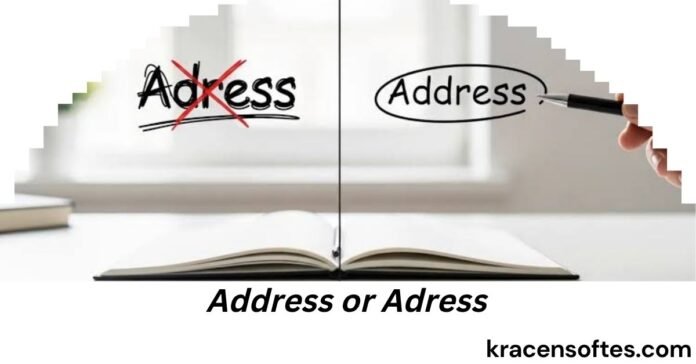
If you have searched for “address or adress,” you are not alone. The word “address” is commonly misspelled, especially when typing quickly or learning English. The correct spelling in standard English is address, with two “d” letters and two “s” letters.
The spelling “adress” is incorrect in modern standard English, although it is a very common typing and spelling mistake. Other variations such as “addres,” “addreses,” “addresed,” “adresss,” “adres,” “adreses,” “adrees,” and “adresses” are also generally incorrect spellings of the English word “address.”
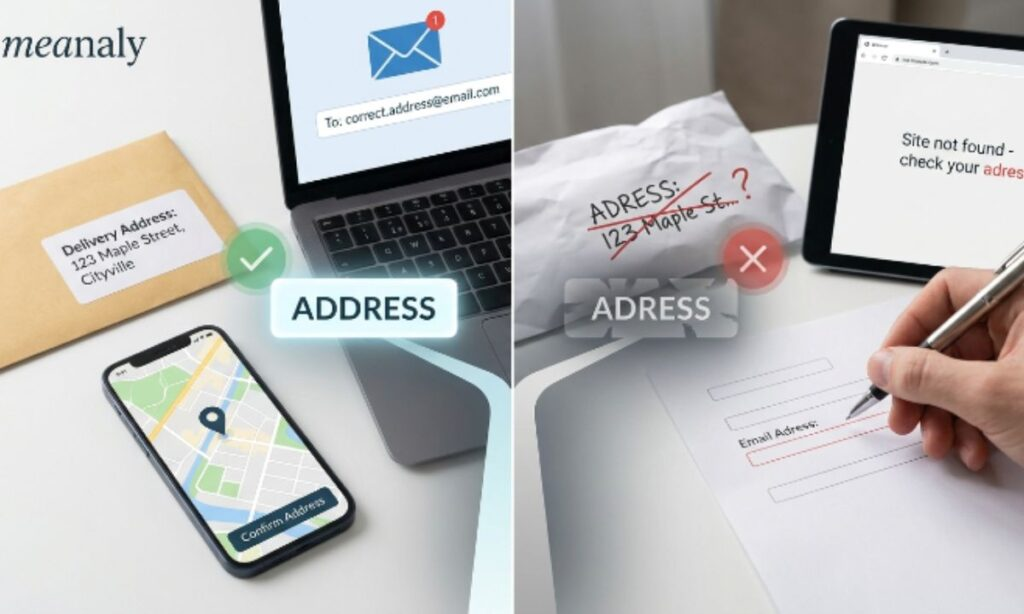
In the United States, the word “address” has several important meanings. It can refer to a home location, a mailing location, an email address, a web address, or even the act of speaking to an audience. Understanding the correct spelling and meaning can help with forms, applications, business communication, online accounts, and everyday writing.
This guide explains the difference between “address” and “adress,” shows how to use the word correctly, and answers common questions about its spelling, pronunciation, meaning, and different types of addresses.
Address or Adress: Which Spelling Is Correct?
The correct spelling is address.
The incorrect spelling is adress.
Here is the simple comparison:
| Spelling | Correct? | Example |
| address | Yes | Please enter your address. |
| adress | No | This is a common spelling mistake. |
| addres | No | Missing an “s.” |
| addreses | No | Incorrect plural spelling. |
| addresed | No | Incorrect past-tense spelling. |
| adresss | No | Extra “s.” |
| adres | No | Missing letters. |
| adreses | No | Incorrect spelling. |
| adrees | No | Incorrect spelling. |
| adresses | No | Incorrect spelling. |
The easiest way to remember the correct spelling is:
address = ad + dress
It contains two “d” letters and two “s” letters:
A D D R E S S
A useful memory trick is to think of the word as having a “dress” inside it:
ad + dress = address
This is not the historical origin of the word, but it can be a helpful spelling trick.
What Does Address Mean?
The word “address” has several meanings in English.
The most common meaning is a location where a person, home, organization, or business can be found.
For example:
What is your home address?
An address can also identify a place where mail should be delivered.
For example:
Please write your mailing address on the form.
However, “address” is not limited to physical locations. It can also refer to an email address or a website address.
For example:
What is your email address?
The word can also be used as a verb. In that case, “address” can mean to deal with a problem, communicate with someone, or speak to an audience.
For example:
The company needs to address the customer’s complaint.
Or:
The president addressed the nation.
Because of these different meanings, “address” is a very useful and frequently used English word.
Why Is “Adress” a Common Misspelling?
“Adress” is a common spelling mistake because English spelling does not always match pronunciation.
When people say “address,” the word may sound like it has a single “d” in fast speech. This can make it easy to forget the second “d” when writing.
The ending can also cause confusion. Some people remember that the word ends in “ss” but accidentally remove one “s” or add an extra one.
Also Read: The Benefits of Scheduling Regular LiftMaster Garage Door and Gate Opener Maintenance
This can result in mistakes such as:
- adress
- addres
- adresss
- adrees
- adres
Another reason is typing speed. When people enter information into websites, online forms, or mobile devices, they may type “adress” without noticing the missing letter.
Fortunately, spell-checking tools often recognize “adress” and suggest “address.”
How Do You Spell Address Correctly?
The correct spelling is:
A-D-D-R-E-S-S
Break it into parts:
AD + DRESS
The word has:
- 2 “d” letters
- 1 “r”
- 1 “e”
- 2 “s” letters
So the full spelling is:
address
A simple sentence to practice is:
Please enter your complete address.
Another example is:
I sent the package to the correct address.
How Do You Pronounce Address?
The pronunciation of “address” can vary depending on the type of English and whether it is used as a noun or verb.
In American English, the noun “address” is commonly pronounced with stress on the first syllable:
AD-dress
The verb can often be pronounced with stress on the second syllable:
uh-DRESS
For example:
What is your address?
Here, “address” is a noun.
But:
We need to address this problem.
Here, “address” is a verb.
This difference in pronunciation can be useful for English learners because the same spelling can have different pronunciation patterns depending on how the word is being used.
What Is a Physical Address?
A physical address identifies a specific location.
For a typical home in the United States, a physical address may include:
- Street number
- Street name
- Apartment, unit, or suite number if applicable
- City
- State
- ZIP Code
For example, a fictional address might look like:
123 Example Street, Apt. 4B
Chicago, IL 60601
This example is fictional and should not be used as a real mailing destination.
Physical addresses are commonly used for homes, apartments, offices, stores, schools, government buildings, and other locations.
What Is a Mailing Address?
A mailing address is the location used for receiving mail.
A mailing address may be the same as a person’s home address, but it does not always have to be.
For example, someone might live at one location but receive mail through a post office box.
A mailing address can include:
- Recipient name
- Street address
- Apartment or unit number
- City
- State abbreviation
- ZIP Code
Correct formatting is important because postal services and delivery companies use address information to identify destinations.
What Is a Home Address?
A home address is the location where a person lives.
People may need to provide a home address when:
- Opening certain accounts
- Completing official forms
- Receiving packages
- Registering for services
- Applying for documents
- Updating records
- Receiving correspondence
Because a home address is personal information, it should not be shared publicly without a good reason.
What Is a Business Address?
A business address identifies where a company or organization operates or receives mail.
A business may have:
- A physical office
- A storefront
- A headquarters
- A registered business address
- A mailing address
- A virtual office address
These addresses can serve different purposes.
For example, a company may have an office in one city but use a separate mailing location for correspondence.
When dealing with a business, it is important to determine which type of address is being requested.
What Is an Email Address?
An email address is different from a physical address.
An email address identifies a destination for electronic messages.
A basic email address normally includes:
username + @ + domain
For example:
example@example.com
The “@” symbol separates the username from the domain.
People use email addresses for:
- Sending and receiving messages
- Creating online accounts
- Password recovery
- Business communication
- Newsletters
- Customer support
- Digital services
The word “address” is therefore used in both physical and digital communication.
What Is a Web Address?
A web address is the location of a webpage on the internet.
It is commonly called a URL, which stands for Uniform Resource Locator.
For example, a website may use an address such as:
A web address can lead to:
- A homepage
- An article
- A product page
- A login page
- A contact page
- A government resource
- An online service
Because internet addresses can sometimes be long, users may copy and paste them rather than type them manually.
Address vs. Location: What Is the Difference?
“Address” and “location” are related, but they are not exactly the same.
A location describes where something is situated.
An address provides a specific identifying format for that location.
For example, someone might say:
The store is located downtown.
That describes the general location.
A more precise statement could provide the store’s street address.
This distinction is useful because a location can be broad, while an address is often more specific.
Address vs. Residence
“Residence” refers to the place where someone lives.
“Address” identifies the location of that place.
For example:
Her residence is in Texas.
A form might instead ask:
What is your current residential address?
The terms can overlap, but “address” is more commonly used when a specific location is needed.
Address vs. Mailing Address
These terms can also have different meanings.
An “address” might refer to a person’s home, workplace, or another location.
A “mailing address” specifically identifies where mail should be sent.
For example, a person may have:
- Residential address: their home
- Mailing address: a PO Box
- Work address: their employer’s office
When filling out a form, always read the exact wording carefully.
Address Formatting in the United States
United States addresses generally follow a predictable structure.
A standard residential address can be written like this:
Full Name
123 Example Avenue
Dallas, TX 75201
An apartment address may include a unit number:
Full Name
123 Example Avenue, Unit 5
Dallas, TX 75201
For a business:
Example Company
123 Example Avenue, Suite 200
Dallas, TX 75201
The state is normally written using its standard two-letter postal abbreviation.
For example:
- California = CA
- Florida = FL
- New York = NY
- Texas = TX
- Washington = WA
The ZIP Code helps identify the delivery area.
What Is a ZIP Code?
A ZIP Code is part of a United States mailing address.
ZIP stands for Zone Improvement Plan.
A standard ZIP Code has five digits, such as:
10001
Some addresses use a ZIP+4 format, which adds four additional digits:
10001-1234
ZIP Codes help the postal system sort and deliver mail efficiently.
When entering an address online, make sure the ZIP Code matches the city and state information whenever possible.
What Does “Address Line 1” Mean?
Online forms often divide an address into several fields.
“Address Line 1” usually contains the primary street information.
For example:
123 Example Street
“Address Line 2” is commonly used for additional information such as:
- Apartment number
- Unit number
- Suite number
- Building number
- Floor
For example:
Address Line 1: 123 Example Street
Address Line 2: Apartment 4B
Not every address needs Address Line 2.
What Does “Address Line 2” Mean?
Address Line 2 provides additional location information.
For an apartment, it may contain:
Apt. 5
For an office:
Suite 200
For a building:
Building B
If the form does not require Address Line 2 and you do not have additional address information, it can usually be left blank.
What Is a Billing Address?
A billing address is an address associated with a payment account or billing information.
It may be requested when making an online purchase or managing a financial account.
A billing address is not necessarily the same as the shipping address.
For example:
- Billing address = address connected with payment information
- Shipping address = location where an order should be delivered
They can be identical, but they can also be different.
What Is a Shipping Address?
A shipping address is the destination where a package or physical order should be delivered.
When ordering something online, users often enter:
- Name
- Street address
- Apartment or unit
- City
- State
- ZIP Code
A small mistake can cause delivery problems.
Common errors include:
- Missing apartment numbers
- Incorrect ZIP Codes
- Misspelled street names
- Wrong house numbers
- Missing state information
Reviewing the address before placing an order can prevent unnecessary delays.
Why Is the Correct Address Important?
An accurate address helps people and organizations communicate with you.
A correct address can be important for:
- Mail delivery
- Package delivery
- Government correspondence
- Employment documents
- School records
- Insurance documents
- Business communication
- Online purchases
- Service appointments
A single incorrect number can sometimes direct mail or a package to a completely different location.
Common Address Spelling Mistakes
The following are common misspellings related to “address”:
Adress
“Adress” is one of the most common incorrect forms.
Correct:
address
Incorrect:
adress
Addres
“Addres” leaves out the final “s.”
Correct:
address
Incorrect:
addres
Addreses
“Addreses” is sometimes used when someone tries to create the plural of “address.”
The correct plural is:
addresses
Addresed
“Addresed” is an incorrect spelling of the past tense.
The correct form is:
addressed
Adresss
“Adresss” contains an extra “s.”
The correct spelling remains:
address
Adres
“Adres” is missing letters and is not the standard English spelling.
Adreses
“Adreses” is another incorrect form that may appear when people attempt to spell the plural “addresses.”
Adrees
“Adrees” changes the spelling of the middle portion of the word.
The correct spelling is:
address
Adresses
“Adresses” is another common misspelling of the plural or verb forms.
The standard spelling is:
addresses
or:
addressed
depending on the intended meaning.
What Is the Plural of Address?
The plural of “address” is:
addresses
For example:
The company has offices at several addresses.
The spelling changes slightly when the word becomes plural.
Singular:
address
Plural:
addresses
The ending is pronounced differently as well, depending on the word’s use and pronunciation pattern.
What Is the Past Tense of Address?
The past tense and past participle are:
addressed
For example:
The manager addressed the problem.
The spelling is:
A-D-D-R-E-S-S-E-D
It contains the original “address” followed by “ed.”
Is “Adress” Ever Correct?
For standard modern English writing, “adress” is generally not correct.
If you are writing an email, application, essay, website, business document, or official form in English, use:
address
“Adress” may appear in user-generated content, search queries, usernames, informal typing, or text containing spelling errors.
Its appearance does not make it the standard spelling.
Why Do People Search “Address or Adress”?
People may search “address or adress” because they are unsure which spelling is correct.
Searchers may be:
- English learners
- Students
- Job applicants
- Online shoppers
- Website users
- People completing forms
- Writers checking spelling
- People typing quickly on mobile devices
The search intent is usually straightforward: the person wants to confirm the correct spelling and understand how the word should be used.
This is an example of a spelling-related search query where a short answer is often enough, but understanding the broader uses of the word can also be helpful.
Address in Everyday English
“Address” appears in many everyday situations.
You might use the word when:
- Asking someone where they live
- Sending a letter
- Ordering a package
- Creating an email account
- Visiting a business
- Filling out an application
- Registering for an online service
Examples include:
Can you send me your address?
I need your mailing address.
Please check the delivery address.
What is the company’s business address?
Enter your email address below.
These examples show why learning the correct spelling is useful.
Address as a Verb
The word “address” can also be a verb.
In this form, it can mean “deal with” or “respond to.”
For example:
The company addressed the customer’s concerns.
Here, “address” does not mean a street location.
It means that the company dealt with or responded to the concerns.
Another example is:
The report addresses several important issues.
This means the report discusses or deals with those issues.
Addressing a Person
“Address” can also refer to speaking to someone directly.
For example:
She addressed the audience.
This means she spoke to the audience.
In formal communication, “addressing” someone can also mean using an appropriate name or title.
Also Read: Recyclatanteil: Meaning, Recycled Content, Calculation, Benefits, and Why It Matters
For example, a letter may begin with a person’s name or professional title.
Choosing the correct form of address can be important in professional communication.
Formal and Informal Address
The way you address someone depends on the situation.
In a professional setting, people may use:
- Mr.
- Ms.
- Dr.
- Professor
- A professional title
- A person’s full name
In casual communication, first names are often appropriate.
The best choice depends on the relationship, workplace culture, and context.
When unsure, a respectful and neutral form is usually a safe starting point.
Address and Online Privacy
An address can be sensitive personal information.
A home address can help identify where someone lives, so it should be handled carefully.
Avoid posting your full home address publicly on social media, public forums, comment sections, or other websites unless there is a clear reason to do so.
When entering an address online, consider:
- Who operates the website?
- Why is the information required?
- Is the website legitimate?
- Is the connection secure?
- Does the service explain how information is used?
- Can you limit the information you provide?
Privacy awareness is especially important because addresses can be combined with other information to create a detailed profile of a person.
Address Safety When Shopping Online
Before entering a shipping or billing address, make sure you are using the correct website.
Be cautious of suspicious websites that request excessive personal information.
Look for signs such as:
- A trustworthy domain
- Clear company information
- Secure connection
- Reasonable payment options
- Clear privacy information
- Professional contact information
A padlock icon or HTTPS connection can help protect data while it is being transmitted, but it does not automatically prove that a website is legitimate.
Users should still verify the website before providing personal information.
Address Privacy and Public Records
In the United States, some address information may appear in public records depending on the jurisdiction and the type of record.
This can create privacy concerns for individuals who want to keep their residential information less visible.
People with specific safety concerns may want to research applicable privacy programs and state laws or consult an appropriate legal or government resource.
Privacy rules vary by state and situation, so general internet advice should not be treated as legal advice.
How to Check an Address Before Mailing Something
Before sending a letter or package, review the address carefully.
Check:
- Recipient’s name
- Street number
- Street name
- Apartment or unit
- City
- State
- ZIP Code
For international destinations, additional information may be required.
Using a recognized postal or delivery service can also help verify address formatting.
How to Write an Address on an Envelope
For a typical U.S. envelope, the recipient’s address is normally placed in the center area of the front.
A basic format is:
Recipient Name
Street Address
City, State ZIP Code
The sender’s return address is commonly placed in the upper-left area.
Proper placement helps automated and human postal processing.
Address and Search Engines
People sometimes use “address” in search engines to find a business, organization, or location.
For example, someone may search for:
company name address
or:
restaurant address
Search engines and mapping services can provide location information, but users should confirm important details through reliable sources.
Business locations can change, and online listings may occasionally contain outdated information.
Address and Maps
Digital maps have changed how people use addresses.
Today, users can often enter an address into a mapping application to:
- Find a location
- Get driving directions
- Estimate travel time
- Identify nearby places
- Share a destination
However, not every location is easy to identify through a simple street address.
Rural areas, new developments, private roads, and buildings with multiple units can sometimes create address-matching challenges.
Address Verification
Address verification is the process of checking whether an address is complete and formatted correctly.
Businesses may use address verification for:
- Shipping
- Customer records
- Billing
- Fraud prevention
- Delivery services
- Data quality
Address verification does not necessarily prove that a specific person lives at an address. It may simply confirm that the address appears valid or deliverable.
That distinction is important when interpreting verification results.
Address Standardization
Address standardization means converting address information into a consistent format.
For example, one person might write:
123 Main Street
while another might enter:
123 Main St.
Both may refer to the same location.
Standardization helps organizations process addresses consistently.
This is especially useful for companies managing large customer databases.
Address Changes
People move for many reasons, including:
- New jobs
- Family changes
- Education
- Housing changes
- Retirement
- Relocation
When someone moves, it may be necessary to update their address with relevant organizations.
These may include:
- Employers
- Banks
- Insurance providers
- Government agencies
- Schools
- Subscription services
- Online retailers
Keeping important records updated can help prevent missed documents and deliveries.
Address Change and Mail Forwarding
People moving within the United States may use mail-forwarding services to redirect eligible mail from an old address to a new one.
However, forwarding does not mean every organization automatically receives the new address.
It is still important to update important accounts and records directly.
Address Mistakes on Official Forms
Address errors on official forms can sometimes create delays.
Before submitting a form, check:
- Spelling
- House or building number
- Apartment number
- City
- State
- ZIP Code
If the form asks for a previous address, mailing address, residential address, or permanent address, make sure you understand the difference before entering information.
Address for Apartment Buildings
Apartment addresses often require extra information.
A basic format might be:
123 Example Street
Apt. 7
Boston, MA 02108
Some buildings use:
- Apartment
- Apt.
- Unit
- Suite
- Floor
- Building
Use the format requested by the relevant delivery service or organization.
Address for Businesses and Offices
Business addresses may include a suite or floor number.
For example:
Example Company
500 Market Street, Suite 300
San Francisco, CA 94105
Including the correct suite number can be essential in a large office building.
Without it, mail or deliveries may be delayed or returned.
Address for Rural Locations
Rural addresses can sometimes use different formats from typical urban street addresses.
Some locations may use:
- Rural route information
- Highway route information
- Box numbers
- PO Boxes
The appropriate format depends on the location and postal system.
When unsure, use the official address provided by the recipient or relevant postal authority.
Address for a PO Box
A PO Box is a secure box located at a post office or another authorized facility.
A basic mailing format may look like:
Recipient Name
PO Box 123
City, State ZIP Code
A PO Box is not the same as a physical street address.
Some organizations require a physical address and may not accept a PO Box.
Also Read: Babeltee: The Emerging Customizable Tea Concept
Common Questions About Address Spelling
Is “adress” the correct spelling?
No. “Adress” is generally a misspelling. The correct English spelling is “address.”
Is “addres” correct?
No. “Addres” is missing the final “s.” The correct spelling is “address.”
How do you spell addresses correctly?
The plural form is “addresses.” It is spelled A-D-D-R-E-S-S-E-S.
How do you spell addressed?
The correct spelling is “addressed,” as in “The manager addressed the issue.”
Why do people spell address as adress?
“Adress” is commonly caused by fast typing, pronunciation confusion, or uncertainty about English spelling. Spell-checking tools can usually identify the mistake.
FAQ About Address or Adress
1. Is “adress” accepted in American English dictionaries?
“Adress” is not the standard spelling of the English word. Standard American English uses “address.” If you are completing a professional document, school assignment, application, or official form, use “address.”
2. What is the easiest way to remember the spelling of address?
A useful memory trick is to divide the word into “ad” and “dress”:
ad + dress = address
This helps you remember that the word has two “d” letters and two “s” letters.
3. Can address mean something other than a home location?
Yes. “Address” can refer to a mailing location, business location, email address, web address, or another identifying location. As a verb, it can also mean to deal with an issue or speak to an audience.
4. Should I use “address” or “location” on a form?
Use the term requested by the form. “Address” usually asks for a specific identifying location, while “location” can sometimes refer to a broader place. If a form is unclear, check its instructions before submitting it.
5. Is an email address considered an address?
Yes. An email address is a digital address used to identify where electronic messages should be delivered. It is different from a physical or mailing address, but the general idea of identifying a destination is similar.
Final Thoughts on Address or Adress
When choosing between “address” and “adress,” the answer is simple: address is the correct standard English spelling.
The word is much broader than a simple street location. It can describe a home address, mailing address, business address, billing address, shipping address, email address, or web address. It can also function as a verb meaning to deal with an issue or communicate with an audience.
The related misspellings “addres,” “addreses,” “addresed,” “adresss,” “adres,” “adreses,” “adrees,” and “adresses” are generally incorrect in standard English. Understanding these common mistakes can make writing, form completion, online communication, and professional correspondence easier.
For United States readers, accurate address information is especially important for mail delivery, online shopping, official records, business communication, and digital services. At the same time, an address is personal information, so it should be shared thoughtfully and only when necessary.
In short, remember the simple spelling:
Address = A-D-D-R-E-S-S
When in doubt, choose “address.”